Can a Used Forklift Qualify for the Section 179 Deduction?
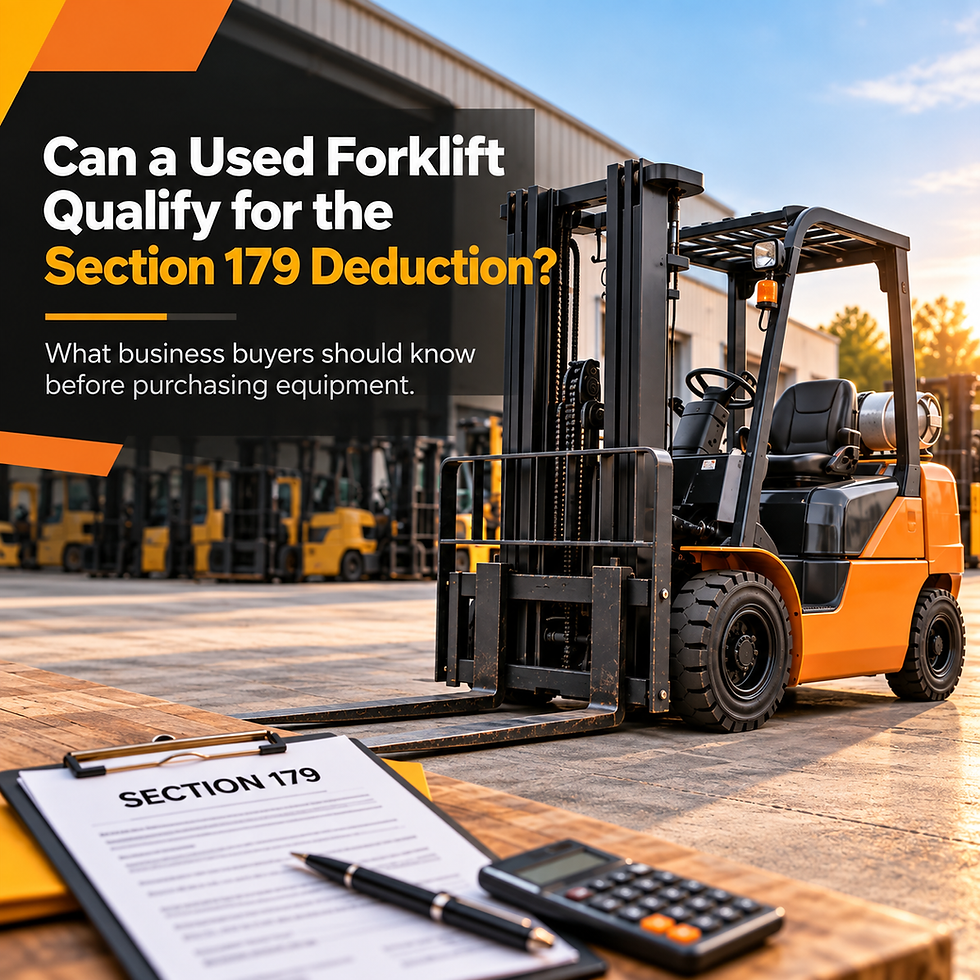
What business buyers should know before purchasing equipment
If your business in Sacramento, the Bay Area, or anywhere across Northern California is considering a forklift purchase, you may have heard about the federal Section 179 deduction. One of the most common questions we hear is whether Section 179 applies only to new equipment.
It may also apply to qualifying used equipment, including a used forklift purchased and placed in service for business use.
That can make Section 179 worth discussing with your CPA when you are comparing equipment options. But the tax deduction should be only one part of the decision. The most important question is still whether the forklift is the right fit for the work.
The right equipment matters more than the tax benefit. Start with the job, capacity, surface, fuel type, lift height, condition, and budget. Then ask your tax professional whether the purchase qualifies for Section 179.
What Is Section 179?
Section 179 is a federal tax provision that may allow a business to deduct all or part of the cost of qualifying equipment in the year the equipment is placed in service, rather than recovering the cost over a longer depreciation period. (Source: IRS Publication 946)
For a business that needs equipment now, that accelerated deduction may be helpful. However, Section 179 is a tax deduction—not a dollar-for-dollar tax credit—and eligibility depends on the buyer’s circumstances.
The IRS generally requires qualifying property to:
Be eligible tangible business property.
Be acquired by purchase.
Be acquired for use in the active conduct of a trade or business.
Be placed in service during the tax year for which the deduction is claimed.
Meet the applicable business-use, income, and other IRS requirements.
(Source: IRS Publication 946)
Can a Used Forklift Qualify for the Section 179 Deduction?
Yes, a used forklift may qualify for the Section 179 deduction if it meets the applicable IRS requirements. Generally, the forklift must be acquired by purchase, used for qualifying business purposes, and placed in service during the tax year for which the deduction is claimed. The forklift must also be new to the purchasing business. Eligibility and the deductible amount depend on the buyer’s specific tax situation, so consult your CPA. (Source: IRS Publication 946)
A used forklift may qualify for Section 179 if it meets the applicable IRS requirements. Section 179 is not limited to brand-new equipment.
For example, a business may purchase a used propane or electric forklift from a dealer and place it into service in its operation. Whether the buyer can claim a deduction—and how much may be claimed—depends on details such as the business’s tax situation, the purchase structure, the date the forklift is placed in service, and how the equipment is used.
The used forklift must also be new to the purchasing business. A business generally cannot buy equipment it already owns and treat it as a new Section 179 purchase simply because it changes locations or internal departments.
Does a forklift have to be new to qualify for Section 179?
No. A forklift does not necessarily have to be brand new. Qualifying used equipment may be eligible if it is purchased by the business, used for qualifying business purposes, and placed in service during the applicable tax year. The used forklift must generally be new to the purchasing business—not equipment the business already owned. (Source: IRS Publication 946)
Does the $10,000 Figure Matter?
There is no general Section 179 rule that limits the deduction to equipment costing $10,000 or less. A qualifying used forklift costing more than $10,000 may potentially be eligible.
The actual deduction is affected by annual Section 179 limits, business income, and other rules. For tax years beginning in 2026, the IRS states that the maximum Section 179 expense deduction is $2,560,000. The deduction begins to phase out when the total cost of qualifying Section 179 property placed in service during the year exceeds $4,090,000. (Source: IRS Publication 946, What’s New for 2026)
Those figures are not a promise that a buyer can deduct the full price of any forklift. They are federal limits that must be considered along with the buyer’s individual tax situation.
Is there a $10,000 limit for Section 179?
No. There is no general $10,000 maximum or minimum Section 179 limit. A qualifying forklift costing more than $10,000 may potentially be eligible. The deduction is subject to annual IRS limits, business-income limitations, and other eligibility requirements. For tax years beginning in 2026, the IRS states that the maximum Section 179 deduction is $2,560,000, with phase-out rules applying when total qualifying equipment purchases exceed the applicable threshold. (Source: IRS Publication 946)
Does Section 179 Apply to Sole Proprietors, LLCs, and Corporations?
Section 179 is not limited to large corporations. Depending on the circumstances, qualifying equipment purchased for business use by a sole proprietor, LLC, partnership, S corporation, or C corporation may be eligible.
The way the deduction is calculated and reported can differ by business structure:
Sole proprietor: The owner generally claims the deduction on the individual tax return, subject to applicable limitations.
Single-member LLC: A single-member LLC is often treated as a sole proprietorship for federal tax purposes unless it elected corporate taxation.
Multi-member LLC: A multi-member LLC is often taxed as a partnership unless it elected to be taxed as a corporation.
Partnership: The partnership generally calculates the applicable deduction and passes amounts through to the partners, usually through Schedule K-1.
S corporation: The deduction generally passes through to shareholders through Schedule K-1, subject to applicable limitations.
C corporation: The corporation generally claims the deduction on its corporate tax return, subject to the applicable rules and limits.
(Source: IRS Instructions for Form 4562)
The business’s legal structure is only one part of the analysis. An LLC’s federal tax classification, the buyer’s taxable business income, and the way the forklift is used can all matter.
Does Section 179 apply to sole proprietors?
Yes. Sole proprietors may be able to claim Section 179 for qualifying business equipment, including an eligible used forklift. The deduction is generally reported on the owner’s individual tax return and is subject to business-income and other IRS limitations. (Source: IRS Instructions for Form 4562)
Does Section 179 apply to an LLC?
Yes. An LLC may be able to use Section 179 for qualifying business equipment. The reporting treatment depends on how the LLC is taxed. A single-member LLC is often treated as a sole proprietorship, while a multi-member LLC is often treated as a partnership. An LLC that elects corporate taxation may follow corporate reporting rules. Ask your CPA how Section 179 applies to your LLC’s tax classification. (Source: IRS Instructions for Form 4562)
What Businesses May Not Qualify?
Having a business entity does not automatically make a purchase eligible. The buyer and the transaction still need to meet the applicable requirements.
The IRS also states that estates and trusts cannot elect the Section 179 deduction. (Source: IRS Publication 946)
Other situations may require special treatment or may limit the deduction, including certain leases, related-party transactions, trade-ins, mixed personal and business use, and purchases that do not meet the applicable business-use requirements. Your CPA can evaluate those details for your business.
Why the Forklift Itself Still Matters for Northern California Operations
A tax deduction should not lead a business to buy the wrong equipment.
Before discussing Section 179 with your tax professional, consider:
Capacity: Do you need a 3,000-pound forklift, or is a 5,000-pound lift actually necessary?
Operating surface: Will the forklift run on smooth pavement, uneven ground, gravel, or dirt?
Tire type: Are cushion tires appropriate, or do you need pneumatic tires for the application?
Fuel type: Would electric or propane work better for the operating environment?
Lift height: Does the forklift reach the required rack or loading height safely?
Condition and maintenance: Is the used forklift in condition to support reliable operation?
Budget and ownership cost: What will the equipment cost to operate, maintain, and eventually trade or resell?
At Simpson Forklift, our approach is simple: Right Equipment, Right Advice. We help businesses compare used forklifts based on the actual job—not simply on a tax deadline or a deduction that may or may not apply.
Questions to Ask Your CPA Before Buying
Consider asking your tax professional:
Does this used forklift qualify as Section 179 property for my business?
What tax year will apply based on the date the forklift is placed in service?
How does my business structure affect the deduction?
Does my business have enough qualifying taxable income to use the deduction?
How would a trade-in, financing arrangement, or lease affect the tax treatment?
Would Section 179, regular depreciation, bonus depreciation, or another approach be appropriate?
What records should I keep for the purchase and placed-in-service date?
Final Takeaway
A qualifying used forklift may be eligible for the Section 179 deduction. This opportunity may be relevant to sole proprietors, LLCs, partnerships, S corporations, and C corporations—not only large companies.
But Section 179 should be a financial consideration, not the primary reason to purchase a particular forklift. First choose equipment that safely fits the work, capacity, surface, fuel, and operating conditions. Then confirm the tax treatment with your CPA before making the purchase.
If you are looking for a used forklift in the Greater Sacramento or Greater Bay Area, the Simpson Forklift Team can help you compare your options and identify equipment that fits your application.
Looking for the right used forklift? Browse current inventory or contact Simpson Forklift to discuss what you need.
Tax Disclaimer
This article is for general educational purposes only and is not tax, accounting, or legal advice. Section 179 eligibility, reporting requirements, deduction limits, and business-income restrictions vary by taxpayer and business structure and may change. Consult your CPA or another qualified tax professional before purchasing equipment or claiming a deduction.


Comments